
WHY DO TROPHEX DRILL SMALL HOLES IN ANTELOPE HORNS - AND WHY IT MATTERS FOR YOUR TROPHY.

Updated: Feb 28
Every single year , we at Trophex get thousands of trophies - not hundreds. Having spent decades working hands-on with African game, we've learned all the ways that things can go pear-shaped when you're dealing with large volumes of skulls and horns, as they clean, dip, pack and ship them off.
Our number one priority is pretty straightforward:
your horns get to you in one piece with the right ones that go with your trophy, and
Your horns arrive overseas in good nick, without any sneaky damage turning up months down the line.
In this blog we'll explain what we've learned, why drilling small holes can often be the best way forward in practical terms, and how those holes are nicely tidied up when we finish the job.
African Antelope Horns - nothing like Deer Antlers
Loads of international clients (especially in the States) are used to white-tailed deer antlers. But African antelope “horns” are completely different.
Deer antlers are solid bone, which grow and shed - they're not a keratin sheath.
Horns (like kudu, gemsbok, blesbok, nyala, wildebeest, hartebeest, impala and many more) are a keratin sheath covering a core, and their shape tapers towards the point.
It's this difference that makes a difference for a couple of very good reasons:
Tagging methods that work on antlers tend not to work on African horn.
Horns can trap moisture, grime, or organic material inside, which can lead to insects later down the line if not treated properly.
Problem #1 : Horn Identification On A Large Scale (Why Tags Can't Be Left to Fall Off)
When you're processing thousands of skulls, horns get handled all the time. With species like kudu, gemsbok, blesbok, nyala, and others, the horn sheath is taken off from the skull during processing - so the horns need to be marked spot on from the start.
Loads of people assume the best way to do it is to tie a tag around the horn. But unfortunately for African horns this is a bad idea:
African antelope horns slope upwards, so a tag tied around the horn can creep upwards during handling.
Eventually it becomes loose and then falls off.
If a tag falls off, you can end up with horns that have no identity - and that creates a much bigger problem than a tiny hole ever could.
If a horn loses its tag, there's a real risk of horns getting mixed up or swapped - for instance, a kudu could end up packed with one correct horn and one horn that belongs to a different trophy. That is a nightmare for the client and for the taxidermy process, and it can be really hard to fix once it's been shipped.
Our solution
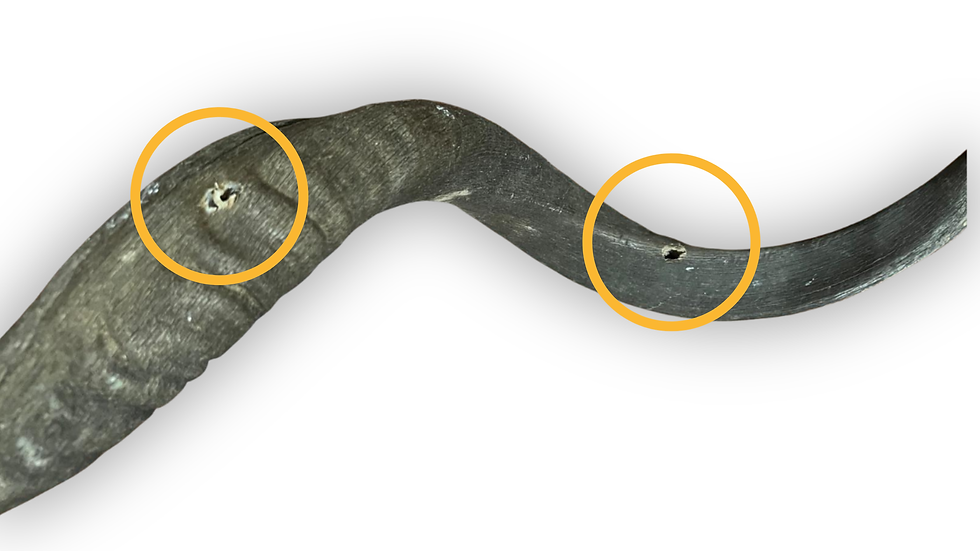
We drill a small hole near the tip of the horn and secure the tag through that hole. The tag won't move or come loose during handling - it's that simple.
This little trick is one of the reasons our horn identification stays spot on even at very high volumes.

Problem #2 : Horn Removal Requires Water Flow Inside The Horn (Kudu, Nyala, Blesbok etc.)
For species where the horn sheath needs to be removed from the skull (kudu, nyala, blesbok and similar types), part of the process involves placing the skull in hot water.
To get the horn sheath off cleanly, hot water needs to be able to flow right the way up from the base of the horn all the way to the tip inside the horn.
If water can't get inside the horn properly, the horn sheath can "stick" to the core.
Then the horn can't be removed in one go, and the process becomes tricky and a bit hairy.
Why we drill holes for this
We drill holes so hot water can flow in and out correctly. For the best cosmetic result, we drill these holes at the back of the horn, so when the trophy is mounted and displayed on a wall, you won't even notice them.
Once the water has done its stuff inside the horn, the horn loosens and can be removed properly.
Problem #3 : Some Species' Horns Can't Be Removed - But Still Need Proper Treatment (Wildebeest, Hartebeest, Impala etc.)
For species like wildebeest, red hartebeest, impala, and others, the horn sheath can't be removed from the skull in the same way.
Even after the skull has been cleaned, there is still a very high chance that traces of flesh or organic material are still stuck inside the horn. That material is hidden, and you can't see it from the outside.If that remains untreated, insect larvae can develop later - often months and months later - and that's usually when the trophy is already snug inside a shipping crate.
Why this is so big of a deal
When those larvae start feasting inside the horn, they can:
make a whole bunch of tiny holes on the inside of the horn,
mess with the horn's structure,
and in worst case scenarios, even destroy a chunk of the horn base.
And because it all happens inside a crate during a long shipping journey, no one spots the problem until its way too late.
Our special prevention method
We give these skulls a special treatment using Formalin to make sure nothing can start breeding inside the horns.
But here is the crucial bit:
Formalin needs to get all the way to the tip of the horn, and that only happens if there are holes in it.
If there's no hole at all, the horn can form a vacuum/airlock that prevents the liquid from getting through.
So again, we drill a small hole at the back of the horn to let the liquid get a good flow.
Dip & Ship / Dip & Pack: Why We Don't Close the Tag Hole Just Yet
When trophies get sent as dipped and packed “raw material”, we often leave the small tag hole open for two darn good reasons:
The overseas taxidermist might like to close and finish that hole in their own special way.
Most importantly: the tag needs to stay put all the way to the very end when we're packing the trophy.
If we close the hole too soon, we'd have to yank the tag out early - and that ups the risk of a whole bunch of mistakes during packing. Our top priority is stopping the far worse scenario of horns getting mixed up, swapped, or packed wrong.
A small hole that can be closed up neat is a tiny issue. A swapped horn is a major problem.
Full Mounting at Trophex: How We Close the Holes Properly
When Trophex does the mounting ourselves, we handle finishing a bit differently:
When we reach the final stage of the mounting, we close up the holes drilled at the back of the horns.
We keep that tag hole in place until we're all done and the mounted trophy is ready to go into the crate.
Only then, right before we ship it, can we close up that last tag hole (because the risk of a swapped horn is now zero).
This system has worked for years, and since we put this system in place, we've had not a single issue with the wrong horns getting shipped, and no cases of skulls arriving overseas with that nasty horn-infestation damage due to untreated interiors.
Closing the Holes: Pratley Putty (Tough, Clean, Easy to Finish)
One of the big concerns is: "Are those holes gonna be visible?"
Happily, closing these holes is no big deal in professional taxidermy finishing.
We use Pratley Putty, which is rock hard and perfect for clean finish work:
Black Pratley Putty for darker horn colours (like gemsbok, blue wildebeest, impala, etc.)
White Pratley Putty for lighter horns, especially blesbok - and white blesbok naturally.
After the putty is applied, it can be matched to the horn colour and painted in to blend right in. Any experienced taxidermist will know how to do this right, and the repair will be almost impossible to spot.
Also important: those holes are drilled on the back of the horn, so when the trophy is up on the wall, the finished area is naturally hidden from normal viewing angles.
In A Nutshell: A Small Hole Saves a Big Headache
At Trophex, every step of our process is designed to keep your trophy safe - even in the real world where thousands of trophies get handled and shipped internationally.
Drilling tiny holes in horns allows us to:
keep the horn's ID hassle-free and 100% guaranteed,
get the horns removed and processed properly,
make sure treatment chemicals work as they should,
prevent damage that only shows up months later,
and ship trophies overseas in top condition.
A tiny hole is no big deal - a swapped horn, a missing tag or internal horn damage can trash your trophy.
That's why we do it - and it's one of the smartest, most practical steps we've learned from years of experience.


Comments